






















Site under Construction

EFRE Startup-Transfer.NRW Funding (01.04.2025-31.05.2026)
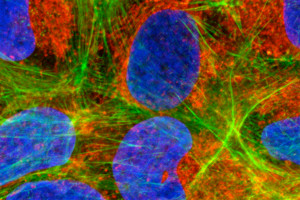
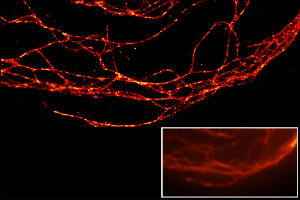
The EFRE Startup Transfer project aimed to develop and technically validate a novel super-resolution (SR) structured illumination fluorescence microscope for biomedical and life-science research. The project focused on combining high spatial resolution with a substantially larger field of view, high imaging speed and a compact system design, addressing limitations of conventional fluorescence microscopy and existing SR techniques.
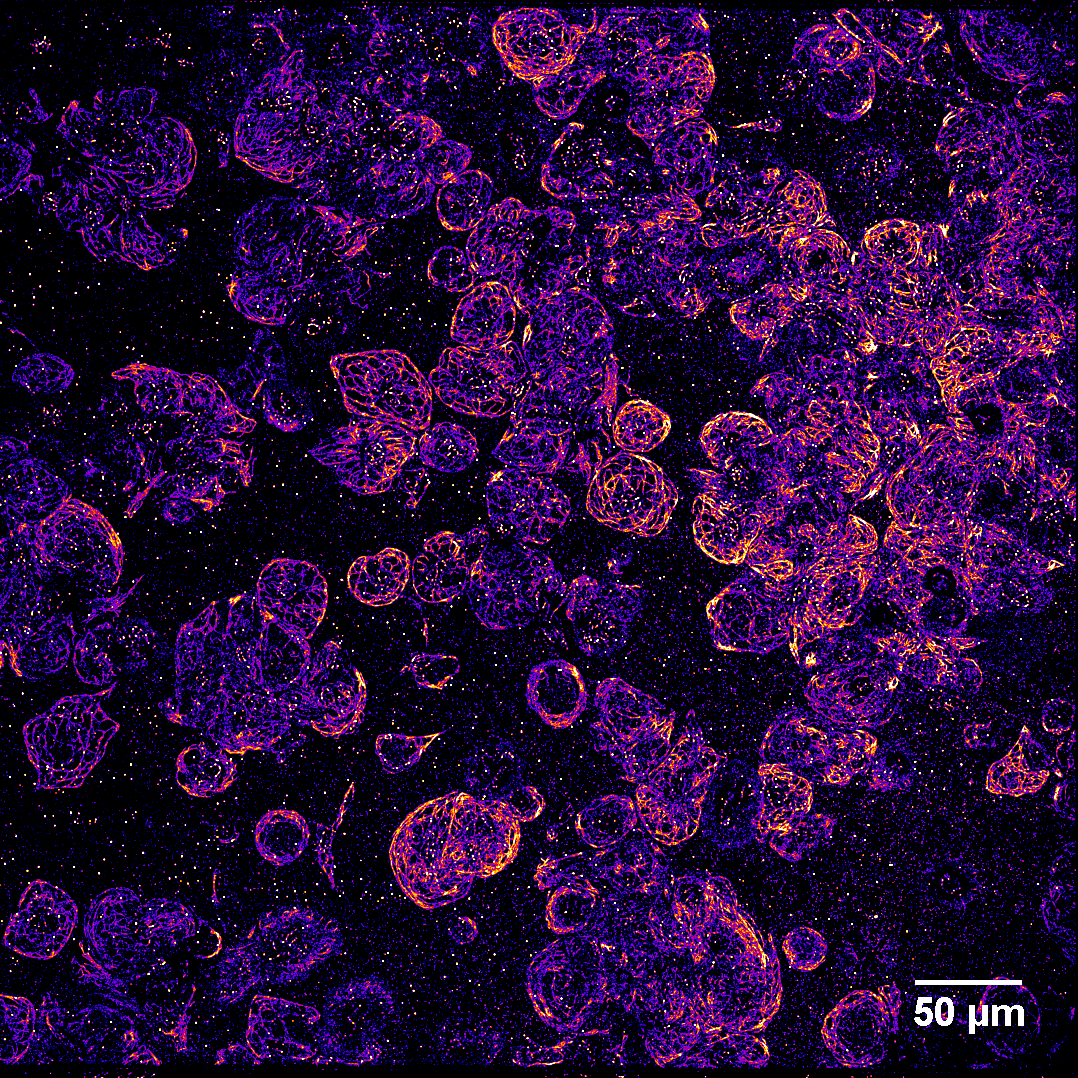
A functional microscope demonstrator was successfully developed and its key optical and technical components were validated. The system provides a field of view of up to 230 × 230 µm² at full resolution, compared with approximately 60 × 60 µm² for typical commercially available SR systems. This enables substantially more cells to be recorded per acquisition and potentially increases measurement throughput by approximately a factor of 15. The large field of view is particularly relevant for applications requiring statistically significant datasets and for the observation of dynamic cellular processes across multiple cells simultaneously.
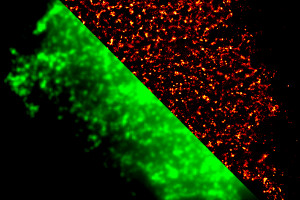
The demonstrator combines several advanced imaging modalities. A novel multi-angle TIRF-SIM approach was demonstrated for high-resolution imaging within a thin volume close to the sample surface. For sample depths of up to approximately 400 nm, it provides a depth resolution of up to approximately 50 nm, compared with around 300 nm for established systems. The main imaging modality, 3D-SIM, benefits from the system architecture through an approximately 30% higher imaging rate. The compact optical design additionally enables the integration of established microscopy modalities without major additional technical infrastructure. Thus, the critical functions of the optical concept and the core imaging principle were successfully demonstrated within the EFRE funding period.
In parallel, important foundations were established for further technical development and commercialization. These included the optimization of the optical and mechanical design, electronics, system control and user interface, as well as the development of automated image-reconstruction software for 3D-SIM data.
Overall, the project successfully demonstrated the feasibility of the microscopy concept and resulted in a functional SR fluorescence microscope demonstrator. The results establish the technological basis for a compact, high-throughput SR microscope combining a large field of view, high spatial and temporal resolution, and multiple imaging modalities, and provide the foundation for further application-specific validation and commercialization.
